1 min read

How Backlogs Are Born and How to Make Sure They Never Come Back

How Backlogs Are Born and How to Make Sure They Never Come Back

The backlog is the great shame of the public service. It fills staff with dread, leaders with pressure and clients with frustration. Every team that has one also tried to attack it - temporary resources, weekend sprints, heroic effort - and most have found it come right back, sometimes bigger than before.

That's because most backlog strategies treat the symptom, not the cause. Until you understand how a backlog forms, you can't stop one from forming again. 

We break down the lifecycle of a backlog with a visual model that most public servants recognize immediately - because they are living it. 
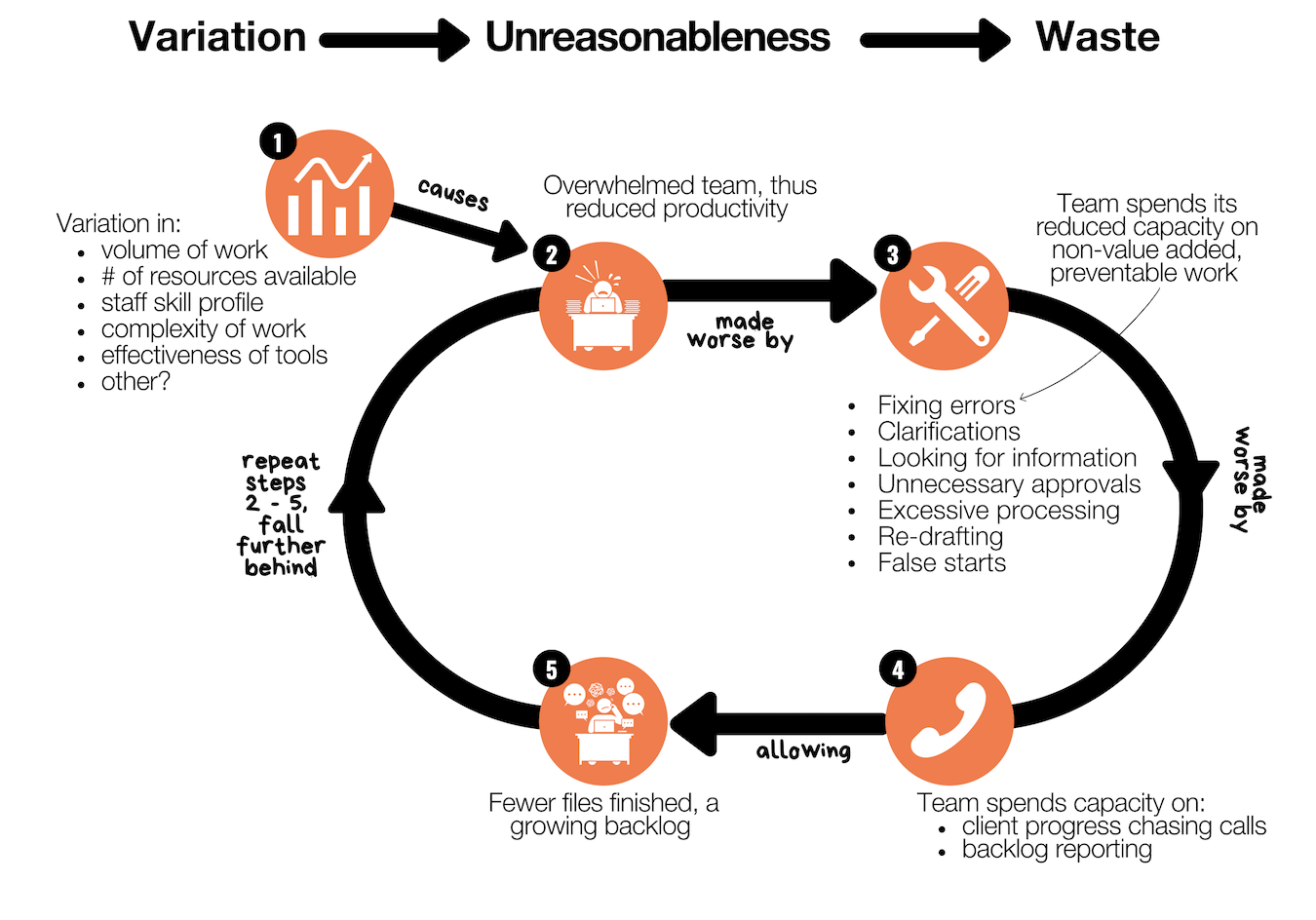
Circular diagram illustrating how backlogs develop: variation in workload (volume, resources, staff skills, complexity, tools) causes an overwhelmed team with reduced productivity, made worse by wasted effort on non-value-added work like fixing errors, clarifications, and unnecessary approvals. This allows capacity to be consumed by client progress-chasing calls and backlog reporting, resulting in fewer files finished and a growing backlog — which repeats the cycle and falls further behind.

Backlogs are not bad luck and they're not caused by lazy teams. They emerge from three distinct and addressable sources:

Variation is the hidden engine behind most backlogs. Work doesn't arrive evenly. Complexity isn't constant. Staff availability fluctuates. When your process is designed for average conditions, anything above average creates a pile-up. Variation in volume, in the skill profile of available staff, in the complexity of incoming files, in the effectiveness of your tools - any one of these can tip a functioning team into chronic backlog territory. Lean teaches you to see variation, measure it, and design for it instead of being blindsided by it.

Overwhelm is what happens when variation isn't addressed. People working in a backlog environment stop performing at their best - not because they don't care, but because chronic overwhelm degrades judgment, increases error rates, reduces communication quality, and burns people out. Overwhelmed teams actually process less work than calm ones. Which makes the backlog worse. Which causes more overwhelm. This is the cycle. It's self-reinforcing, and it's entirely breakable with the right interventions.

Process waste completes the picture. Hidden in almost every backlogged process are the eight Lean wastes - unnecessary handoffs, defects that trigger rework, waiting time between steps, excessive processing steps that add nothing for the client. Each unit of waste extends the time it takes to complete a file, which means the team's capacity is lower than it appears on paper, which means demand exceeds supply even when the numbers look like they shouldn't.

What makes this module particularly compelling is that it's not theoretical. The backlog case study featured in the Lean Yellow Belt program was completed by one of our Yellow Belt graduates as their very first Lean project - a real team, a real backlog, a real government context. They applied what they learned, and they got real results. That's the point: the tools work, and the first time you use them, they can produce results that get noticed.

Building Your Team the Smart Way - First Followers and the Art of Creating a Movement

1 min read

Building Your Team the Smart Way - First Followers and the Art of Creating a Movement

One of the most common mistakes Lean practitioners make is spending enormous entry trying to convince every skeptic in the room. They host...

Read More
Failure Demand: The Work That Should Never Exist

1 min read

Failure Demand: The Work That Should Never Exist

If you asked most managers where their team's capacity is going, they'd tell you: answering emails, processing requests, attending meetings,...

Read More
Metrics That Matter

1 min read

Metrics That Matter

We mapped our process and we’ve found waste everywhere, maybe we even have some ideas about what to do about it. Now we need to decide how we will...

Read More