1 min read
Where AI Actually Saves Time in a Lean Six Sigma Project (And Where It Doesn't)
I've been tracking where AI saves time in Lean process improvement projects. Not the marketing claims - the actual hours, on real engagements, with...
How do you know which slide is the one people care the most about? Easy - it's the one they take pictures of.
In our Practical AI for Process Improvement Specialists course, this is it. Five tiers ranking where AI can deliver value to a business process - from highest to lowest.
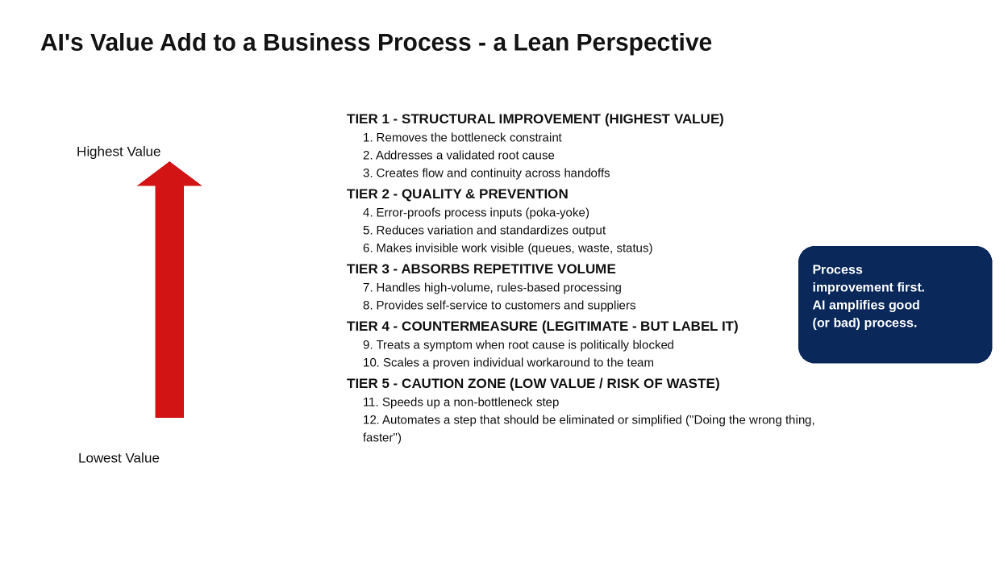
Tier 1 - Structural Improvement (highest value)
Opens the bottleneck constraint. Addresses a validated root cause. Creates measurable improvements to flow across handoffs. This is where AI changes throughput, not just speed at a single step. The investment pays for itself because the system serves more clients with the same or less effort.
Tier 2 - Quality and Prevention
Error-proofs process inputs. Reduces variation and standardizes output. Makes invisible work visible - queues, waste, status. This tier prevents defects rather than catching them downstream and creates the visibility that makes the process easier to manage.
Tier 3 - Absorbs Repetitive Volume
Handles high-volume, rules-based processing. Provides self-service to customers and suppliers. This is where most AI deployments live, and where McKinsey states the most AI applications seem to come from. Real value, but not transformative on its own.
Tier 4 - Countermeasure (legitimate, but label it)
Treats a symptom when the root cause is politically blocked. Scales a proven individual workaround to the team. These uses are sometimes the right call - just be honest with yourself that you're applying a band aid / countermeasure, not a root cause solution. Document the underlying problem so it can be addressed later.
Tier 5 - Caution Zone (low value, risk of waste)
Speeds up a non-bottleneck step. Automates a step that should be eliminated or simplified. This is where many AI investments quietly fail.
MIT research published in 2025 found that 95% of enterprise generative AI pilots produced no measurable bottom-line cost savings, and a 2025 S&P Global survey found that 42% of companies had scrapped most of their AI initiatives before production.
Those failures usually are not about model quality. They are about weak workflow integration, poor data readiness, and bad process design underneath.
Most AI deployments operate in Tier 5 - and don't know it. Most value is created in Tiers 1, 2, or 3. The five tiers are a 30-second mental check that prevents the single most common AI deployment mistake: solving a problem that process improvement should have solved first.
Process improvement first. AI amplifies good (or bad) process.
Key takeaways:
Rank your existing AI initiatives into one of the five tiers:
Tier 1 (structural improvement at the bottleneck or root cause) is where AI changes throughput.
Tier 2 (quality and prevention) is where AI prevents defects and makes invisible work visible.
Tier 3 (absorbs repetitive volume) is where most time savings come from.
Tier 4 (countermeasure) is sometimes legitimate - just label it honestly.
Tier 5 (caution zone) is where most AI investments quietly fail. Doing the wrong thing, faster.
If many fall in tiers 4 or 5, ask yourself what you can do to instead invest in Tiers 1, 2, or 3, so that they can bring real value to your business processes.
Explore our public training programs.
Training ProgramsTalk to us about a working session for your team.
Book a Consultation
1 min read
I've been tracking where AI saves time in Lean process improvement projects. Not the marketing claims - the actual hours, on real engagements, with...
1 min read
A team in HR builds a chatbot to walk hiring managers through a 14-field hiring request form. It takes three months and a meaningful chunk of their...
1 min read
Once you build a chatbot for a bad process, something interesting happens. The chatbot develops a constituency. It has a project team, a budget line,...