Chatbots: Are We Automating What Should be Eliminated?
A chatbot won't fix a bad form. Before adding AI, ask whether the complexity should exist at all. The eliminate-first principle for process...
3 min read
Craig Szelestowski Published Updated
If you work near Information Technology, you know the term "technical debt" - the accumulated cost of every shortcut, workaround, and "we'll fix it later" decision baked into your IT applications and their supporting infrastructure. You can live with technical debt for a while, but eventually the interest payments (slower changes, more bugs, harder onboarding) exceed the speed you gained by not fixing things properly the first time.
Harvard Business Review recently adapted the term for business processes. In a March 2026 article on the "last mile" problem in AI transformation, researchers from Harvard and Microsoft identified process debt as one of seven "frictions" slowing AI value capture.
Process debt is the accumulated weight of:
Individually, none of these feels worth fighting about. Collectively, they are why your 5-day process currently takes 45 days.
Here is the problem AI creates for organizations carrying process debt: AI is very good at speeding up individual process steps.
What it does not change on its own is the end-to-end process.
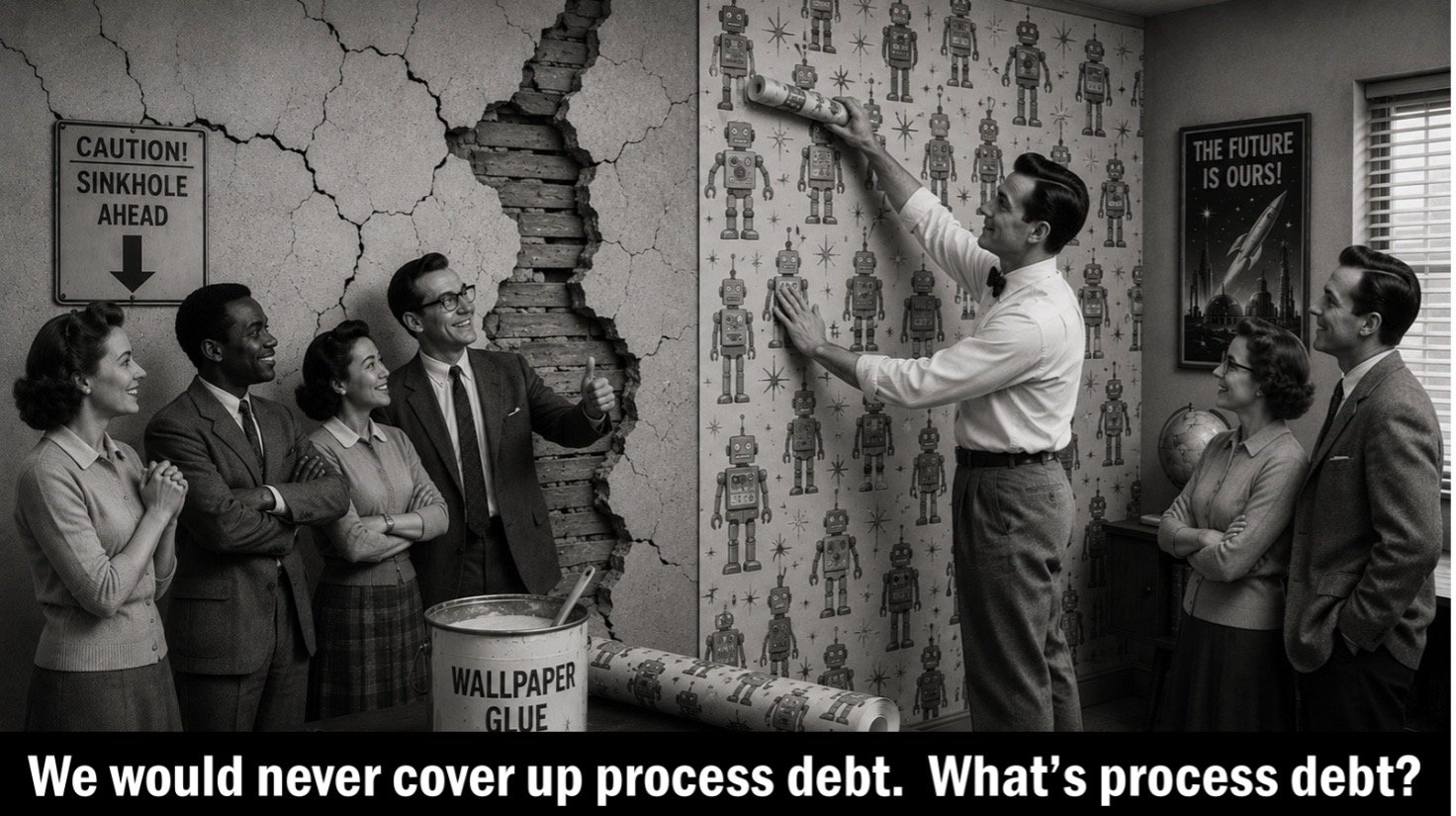
So you end up with a process that is still 45 days end-to-end, but now most steps inside it are "AI-enhanced". You haven't paid down the debt. You have just made the interest payments feel more modern.
Why doesn't AI collapse the 45 days? Because the bottleneck usually isn't the step AI speeds up.
The bottleneck is usually where the waiting is: waiting for a sign-off, a specialist's review, or a critical piece of information from someone too busy to provide it quickly.
AI can make the activities within the steps faster. But the waiting between the steps - which often accounts for 80% or more of the end-to-end lead time - remains unchanged by AI. You can reduce the effort required in every step in a 45-day process by 50% and still have a 45-day process if the wait times are not addressed.
The same HBR team found that only 1% of organizations had achieved mature AI deployment, despite 92% planning to increase AI investment. Why the gap? Because most organizations are automating processes that should have been redesigned first. Or they are building AI solutions on top of data that hasn't been cleaned up. Or they are training agents on workflows that include steps that shouldn't even exist.
The technology works. The process underneath doesn't.
Before you invest in AI for any business process, I suggest a simple diagnostic.
Walk the process end-to-end. For each step, ask: "If I were designing this process from scratch today, would this step be here?" Each time the answer is no, make a note of it. At the end, count up all the times you answered "no". If more than 20% of the steps wouldn't survive a clean-sheet design, you have process debt - and AI is the wrong investment to start with.
The right starting investment is process redesign - paying down the debt first. Which, if you've been reading this series, you know is exactly what Lean does.
Mark Graban at Lean Blog has been saying this in various forms for years: don't automate a bad process. The HBR article is the same message with a more consultant-friendly vocabulary.
You may be thinking that "process debt" is just another way of saying "waste" - muda with a new name. Fair. The reason the "process debt" framing helps is that it speaks to executives in a vocabulary they may recognize from software development - and software-thinking executives are the ones currently approving AI budgets. If borrowing a term gets the conversation started, that's worth doing. The work underneath is still Lean.
AI doesn't pay down process debt. It compounds it. If you want AI to deliver real value, clean up the process first. Then apply AI to what's left.
Key takeaways:
Explore our public training programs.
Training ProgramsTalk to us about a working session for your team.
Book a Consultation
A chatbot won't fix a bad form. Before adding AI, ask whether the complexity should exist at all. The eliminate-first principle for process...

95% of enterprise AI pilots show no measurable savings. This 5-tier framework shows where AI actually adds value in a process, and where it doesn't.

I built a working AI agent in 10 minutes, no code required. Here's why that's a process improvement skill, not a tech one.