2 min read

Every AI Output Is a First Draft. Here's How to Catch Workslop.

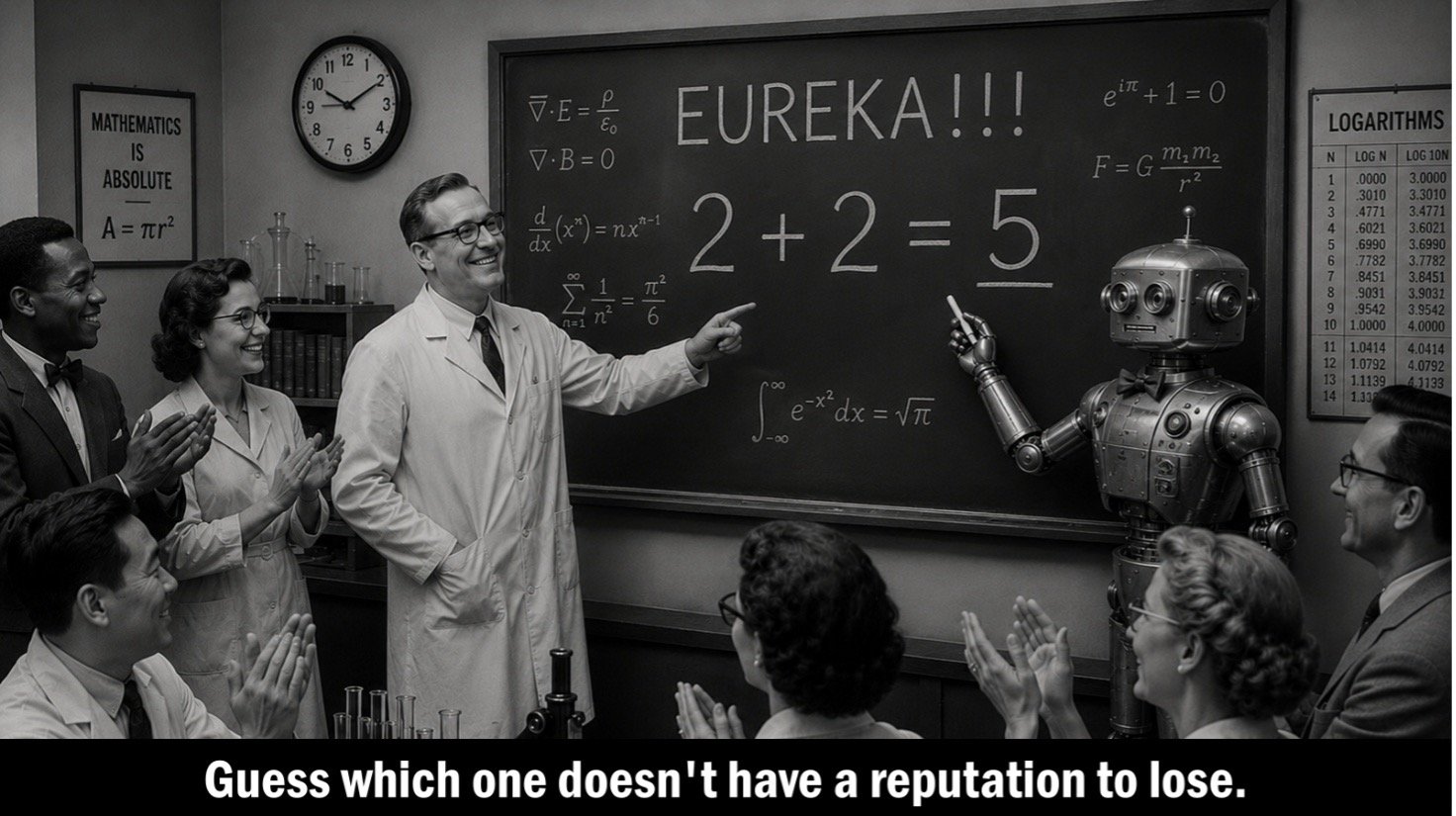
Retro black-and-white illustration of a professor at a chalkboard covered in real equations (Maxwell's equations, Euler's identity, the Basel problem, a Gaussian integral) alongside

You fed your AI a good prompt. The output looks polished. Complete sentences, confident tone, clear structure. Send it?

Not yet.

In September 2025, Harvard Business Review published research from BetterUp Labs and Stanford on something they called "workslop" - AI-generated content that appears polished but lacks real substance. Forty-one percent of workers surveyed had encountered it.

Each instance cost an average of nearly two hours of rework. That rework cost is a quiet ROI-killer of AI adoption programs.

The fix isn’t to use AI less. It is to validate what AI gives you before anyone else sees it. Here is a checklist to consider:

1. Check the math.

AI is confidently wrong about numbers with some regularity. Efficiency calculations, percentages, totals, year-over-year comparisons - do the arithmetic yourself - or have a different AI check the numbers. If the numbers are off in a report, trust will be lost, and it will not come back easily.

2. Verify the quotes.

If you asked AI to summarize interviews and it produced quoted statements, check them against the source. AI will sometimes blend two people’s language into a single quote or paraphrase a comment into stronger language than the person actually used. A quote in a report is a claim about what a real person really said. Make sure to get it right.

3. Ask what it might have missed.

AI is good at summarizing what is in the source. It is less good at noticing what is absent. If a staffing process analysis doesn’t mention classification delays, that doesn’t mean there aren’t any - it means you didn’t include data on them in the prompt. Always ask yourself: "What is this analysis not saying that I know from experience is probably relevant?"

4. Watch for false balance.

AI tends to produce balanced-sounding prose even when the underlying reality is lopsided. If 9 of 10 stakeholders said the process is broken and 1 said it works fine, AI will often write "stakeholders expressed mixed views." Technically true. Materially misleading. Rewrite.

5. Check for political tone-deafness.

AI doesn’t know that the classification officer you are writing about has a decade-old grievance with the HR director you are also writing about. It will produce recommendations that assume everyone in your organization can just talk to each other like adults. Your job is to add the political intelligence AI lacks.

6. Read it out loud.

Reading the text out loud helps you perceive how others might receive it, and can help catch unexpected issues.

Bonus: a verification prompt for cross-checking with a second, different, AI

If you want a second AI to help you check the first one's work, here's a prompt I use:

"You are a critical reviewer. I am providing you with [SOURCE MATERIAL: e.g., interview transcripts, data tables, the case background] and a draft document generated by another AI. Review the draft against the source material and identify: (1) any numerical claims that don't match the source data; (2) any quoted statements that don't appear verbatim in the source; (3) any significant findings from the source that the draft omits; (4) any places where the draft uses inappropriately balanced language ('mixed views', 'some stakeholders') when the source data is actually one-sided; (5) any recommendations that assume organizational dynamics not described in the source. Be specific. Cite the source location for each issue."

This is faster than reading the draft cold and gives you a focused list to verify. Two AIs cross-checking each other catches more than one AI alone. Adds about 3-5 minutes versus 20-30. The remaining 5-10 minutes is yours - to add the political intelligence neither AI has.

Every AI output is a first draft. Your name goes on the second draft.

Key takeaways:

  • "Workslop" - polished AI output with no substance or with hallucinations - costs you rework time, or if you don’t catch it - hurts your reputation.
  • Always check AI math manually. It is confidently wrong more often than you’d expect.
  • Verify quotes against source material. Paraphrasing into a quote is fabrication.
  • Watch for false balance. AI makes lopsided findings sound evenly mixed.
  • Use a structured prompt in a different AI to do a quick check for workslop.
  • Your judgment, political intelligence, and contextual knowledge are what makes the second draft yours.
I Built an AI Agent in 10 Minutes. Here's Why That Matters for Process Improvement

I Built an AI Agent in 10 Minutes. Here's Why That Matters for Process Improvement

I built a working AI agent in 10 minutes, no code required. Here's why that's a process improvement skill, not a tech one.
Read More
What Your Team Is Actually Afraid Of (And What to Do About It)

What Your Team Is Actually Afraid Of (And What to Do About It)

43% of workers fear AI will replace their job within two years. Ignoring that fear backfires. Here's the one commitment leaders must make before AI...
Read More
The AI Investment Trap

The AI Investment Trap

Once an AI tool is built on a bad process, it gains defenders who resist fixing the process. Here's how the AI investment trap works, and how to...

Read More