2 min read

AI at the Bottleneck vs. AI Everywhere Else

AI at the Bottleneck vs. AI Everywhere Else

Imagine you’ve been charged with improving the performance of a sluggish granting process that has been backlogged for years. Clients have been complaining so loudly that even the Minister can no longer ignore it, and now it’s your problem to solve.

Fortunately, you have the perfect solution: AI. The process has three phases - Intake, Analysis, and Approval - and from what you’ve overheard, Analysis is the slowest. You confidently point AI at Analysis.

Many months later, after a couple of IT projects, three consultants, rigorous testing, intense end-user training sessions, and $400k of budget spent, you are no longer feeling so confident. The project results have been mixed at best. On the bright side, the Analyst team very much likes using AI - they’ve saved dozens of hours a week by getting it to extract key info from bulky applications packages, and it writes first drafts of their recommendations like no one’s business. But clients are still unhappy. They are still waiting just as long as before.

How could this possibly be?

The problem is not with the AI deployment; it’s with the process step where it was deployed.

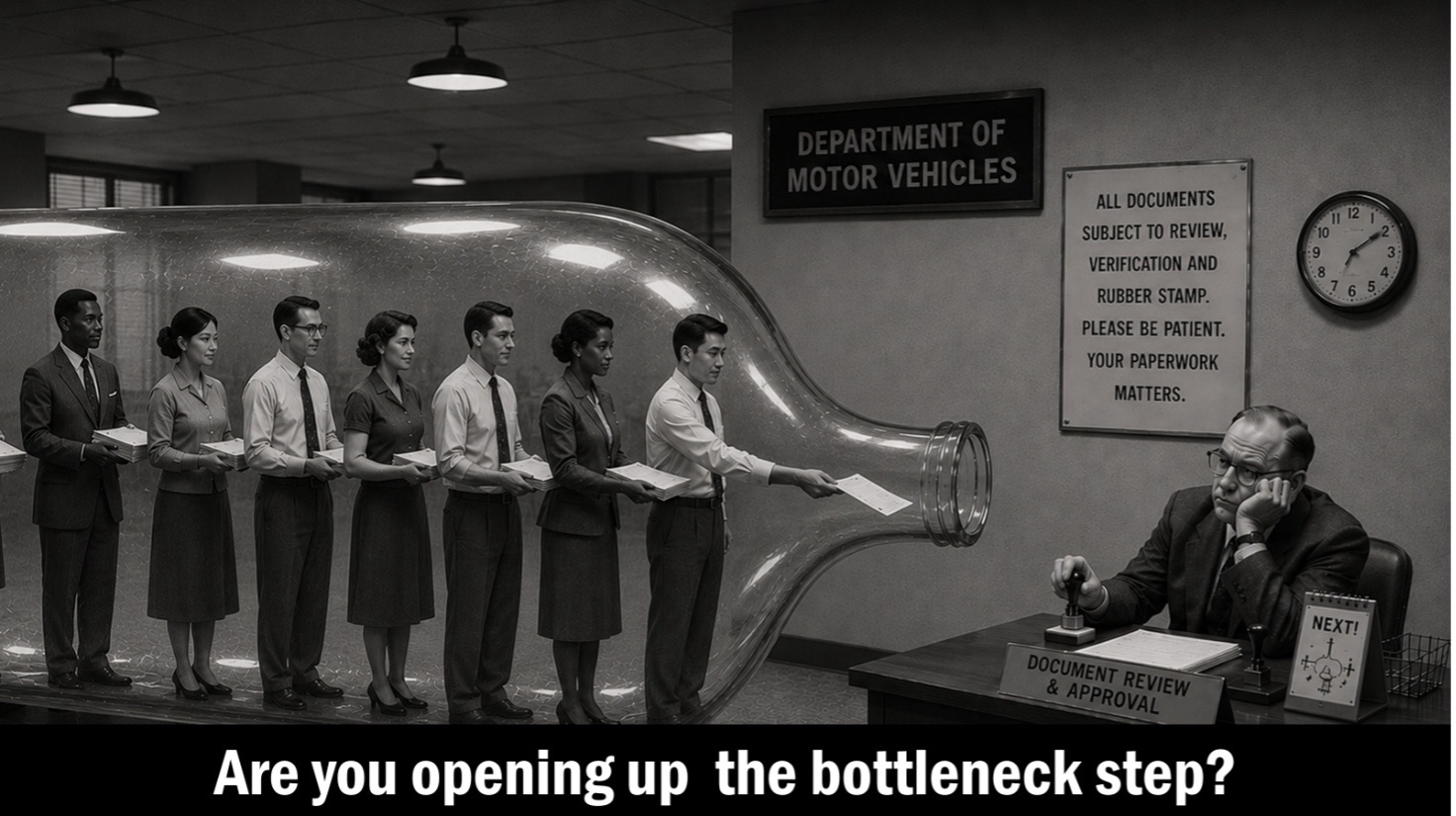
One of the tricky things about processes is that they can only deliver client value at the rate of the slowest step - often referred to as the bottleneck step - in the entire value stream. If you improve the throughput rate of any step other than the bottleneck, you will inadvertently create a bigger backlog at the next step, and the client won’t notice any improvement at all.

If you want to improve a process so that the client feels the benefits, you have to identify and improve the bottleneck step.

Unfortunately, in a digitized work environment, bottlenecks are not visible to the naked eye. You cannot just look around for the biggest stack of papers piled up on someone’s desk. You have to rely on analysis of the process data.

Had you gathered and analyzed the data at each of the three phases, you’d have noticed that, while the actual hands-on time it takes Dave to review and approve a recommendation is only 5 minutes, he performs this task only once a week: every Friday afternoon from 3:30-4:00 pm. If there are more than six in his queue, or it’s a holiday, or he’s not in the office for whatever reason on a Friday afternoon, the untouched approvals have to wait until the following Friday. The process data will tell you that it’s the Approval phase - not Analysis - that needs to be addressed in order to make the client notice.

Key takeaways:

  • Find and fix the bottleneck first. AI may or may not be the right tool to help accelerate the bottleneck step, but the bottleneck must be improved in one way or another before the client will experience any benefit.
  • Any improvement (AI or not) at a non-bottleneck step just creates more backlog downstream, not faster throughput to the client. Although it may free up some local capacity.
  • Before approving an AI investment, ask: "How will the bottleneck be found and fixed so that the end-client benefits?”
  • Once you’ve addressed a bottleneck, it will move to another process step. Go find and fix that step next!
The AI Investment Trap

1 min read

The AI Investment Trap

Once you build a chatbot for a bad process, something interesting happens. The chatbot develops a constituency. It has a project team, a budget line,...

Read More
Where AI Actually Saves Time in a Lean Six Sigma Project (And Where It Doesn't)

1 min read

Where AI Actually Saves Time in a Lean Six Sigma Project (And Where It Doesn't)

I've been tracking where AI saves time in Lean process improvement projects. Not the marketing claims - the actual hours, on real engagements, with...
Read More
I Built an AI Agent in 10 Minutes. Here's Why That Matters for Process Improvement

1 min read

I Built an AI Agent in 10 Minutes. Here's Why That Matters for Process Improvement

Last week I opened up Microsoft 365 Copilot, clicked "Create Agent," and pasted a 10-item checklist for staffing request completeness. Then I tested...

Read More